the world after American purpose
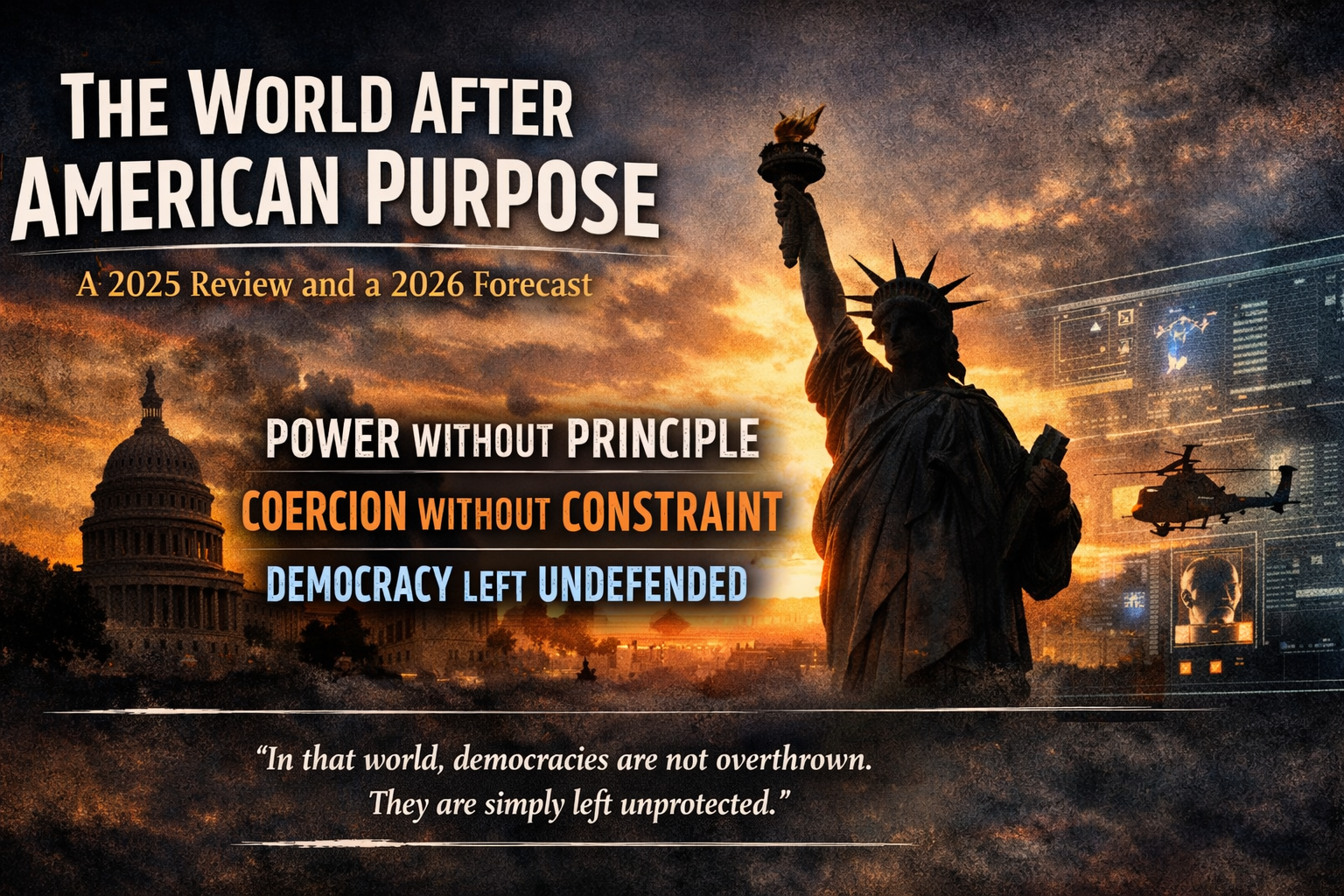
The most consequential geopolitical development of 2025 was not a war, an election, or a treaty. It was the quiet disappearance of American purpose from the global system.
For the first time since World War II, the United States passed through an entire year without its president once articulating the protection of democracy or freedom as a central objective of American foreign policy. This was not a rhetorical oversight; it was a structural shift. In 2025, American power became explicitly transactional, alliances became conditional, and values became optional. The result was not isolationism but abdication, a withdrawal from normative leadership even as military and economic engagement continued.
That shift re-ordered the world faster than any single event could have.
Authoritarian governments did not need to defeat the liberal order in 2025. They simply waited while its principal architect stepped aside.
2026 will be the first year that fully reflects the consequences.
What 2025 Changed
Four developments in 2025 reshaped the system.
First, power formally decoupled from principle. When the United States reduced its rhetorical and financial support for Africa and Eastern Europe, while simultaneously expanding security cooperation with governments exhibiting democratic backsliding, it signaled that the rule of law, freedom, and the protection of human rights were no longer a qualifying condition for partnership. This logic was reinforced when a senior U.S. intelligence assessment in late 2025 publicly downplayed Russia as a primary threat and implied that European security was increasingly a regional, not transatlantic, responsibility, a signal widely interpreted in European capitals as confirmation that the United States no longer saw itself as the guarantor of the continent’s democratic order. It was further underlined by the effective dismantling of USAID’s democracy, governance, and civil society programming, as funding was cut, missions were shuttered, and development assistance was stripped of its normative mandate, removing one of the last institutional tools linking U.S. power to democratic outcomes.
Second, authoritarian clarity replaced democratic ambiguity. China paired its expansion of physical infrastructure under the Belt and Road Initiative with the export of digital surveillance systems, facial recognition, and data platforms to governments in Central Asia, Africa, and the Middle East, explicitly framing these tools as models of “efficient governance.” Russia, meanwhile, avoided decisive escalation in Ukraine and instead normalized a condition of permanent instability through frozen front lines, energy leverage, election interference, and diplomatic stalling, signaling that coercion could be sustained indefinitely without triggering a unified Western response.
Third, information became infrastructure. AI-generated misinformation and deepfakes became a persistent feature of elections across democracies, without a coordinated response, as the United States, including agencies such as the FBI and DHS, explicitly deprioritized foreign influence, information integrity, and democracy-protection missions in favor of narrower definitions of domestic security and crime.
Fourth, the Global South stopped waiting. As American leadership and soft power visibly receded, through the retreat from democracy assistance, the erosion of conditionality, and the absence of a values-based diplomatic agenda, states across Africa, Latin America, and Southeast Asia diversified partnerships accordingly, concluding that democratic alignment no longer reliably delivered security, investment, or political support. This vacuum created space for authoritarian actors to expand influence through infrastructure, financing, security cooperation, and digital governance tools, not because of ideological appeal, but because they were present when the United States was not.
Predictions for 2026
By early 2026, the shifts that emerged in 2025 will no longer be transitional but structural. What follows are the most likely regional expressions of that new equilibrium, not as isolated developments, but as consequences of a system now operating without a clear democratic anchor.
Europe
Europe will remain rhetorically unified but strategically strained, with continued Ukraine support but no defined end state, while the United States likely amplifies internal European divisions by legitimizing illiberal leaders, withdrawing political backing from democratic institutions, and signaling tolerance for nationalist and populist forces that erode liberal norms, accelerating democratic backsliding across the continent. In the United Kingdom, this dynamic will contribute to the replacement of Keir Starmer as prime minister, as political fragmentation and external pressure converge. At the same time, Russia and the United States may find themselves, de facto, on the same side in shaping European electoral environments, not through formal coordination, but through parallel tolerance for and exploitation of forces that weaken liberal democratic cohesion.
Ukraine, Russia, and Eastern Europe
Russia will prioritize fatigue over conquest, using normalization and influence operations. Still, it will shift toward more overt military escalation if Ukraine does not accept territorial concessions by March 2026, betting that Western division and U.S. disengagement will limit the cost of renewed aggression. If President Zelensky were to capitulate under that pressure, it would likely trigger presidential elections in Ukraine in which he would not run, held on the same ballot as a national referendum on the terms of any peace agreement with Russia.
Indo-Pacific
China will test coercive action against Taiwan while the United States remains strategically absent — likely through a sharp escalation of gray‑zone operations (blockade drills, cyber disruption, economic punishment, and political intimidation) that stops short of formal invasion but functions as a de facto assault. The wildcard will be whether Japan moves beyond rhetorical support to provide direct military or logistical assistance to Taiwan, potentially altering Beijing’s risk calculus. Regional states will hedge more aggressively.
Middle East
The region will become more transactional and less restrained, with Israel moving more aggressively to consolidate control over the West Bank, escalating conflict with Hezbollah in Lebanon and with Syria, while Iran continues testing limits via proxies; Turkey under President Erdoğan will increasingly side with Syria diplomatically and militarily in pushing back against Israeli actions.
Africa
Africa will become a central arena of competition, with infrastructure and security outweighing governance concerns; it will become even more fertile ground for Chinese and Russian influence, given the U.S. abandonment. Nigeria, in particular, will move into Washington’s political crosshairs as President Trump amplifies erroneous claims of Christian persecution to mobilize his domestic base ahead of the U.S. midterm elections, as well as work to undermine President Tinubu before the 2027 national elections.
Latin America
Rising public demand for accountability will coexist with declining faith in U.S. partnership, as Venezuela undergoes a likely regime change (realized through U.S. action prompted by desires to take another country’s natural resources), Peru enters a new phase of political turmoil, and President Trump will intervene in Brazil to seek the release of Jair Bolsonaro, further entangling Washington in Latin America’s internal crises.
IN SUMMARY
History may mark 2026 as the year democracy was left to stand alone — not because it was defeated, but because it was abandoned by those who once defended it; abandoned by governments that chose convenience over commitment, silence over solidarity, short-term politics over long-term principle, and personal financial gain over the public good, forcing citizens, courts, journalists, and civil society to shoulder alone what was once the responsibility of a system designed to protect freedom collectively.
The kidnapping of Venezuela’s president by the United States did not reverse this abandonment; it confirmed it. It demonstrated that American power has not disappeared, but that it now operates without the constraints that once distinguished leadership from coercion, law from force, and legitimacy from leverage. The problem is not that the United States no longer acts; it is that it no longer explains its actions in the language of law, democracy, or shared principle.
In that world, democracies are not overthrown. They are simply left unprotected.