America's 250th birthday: The experiment is not over
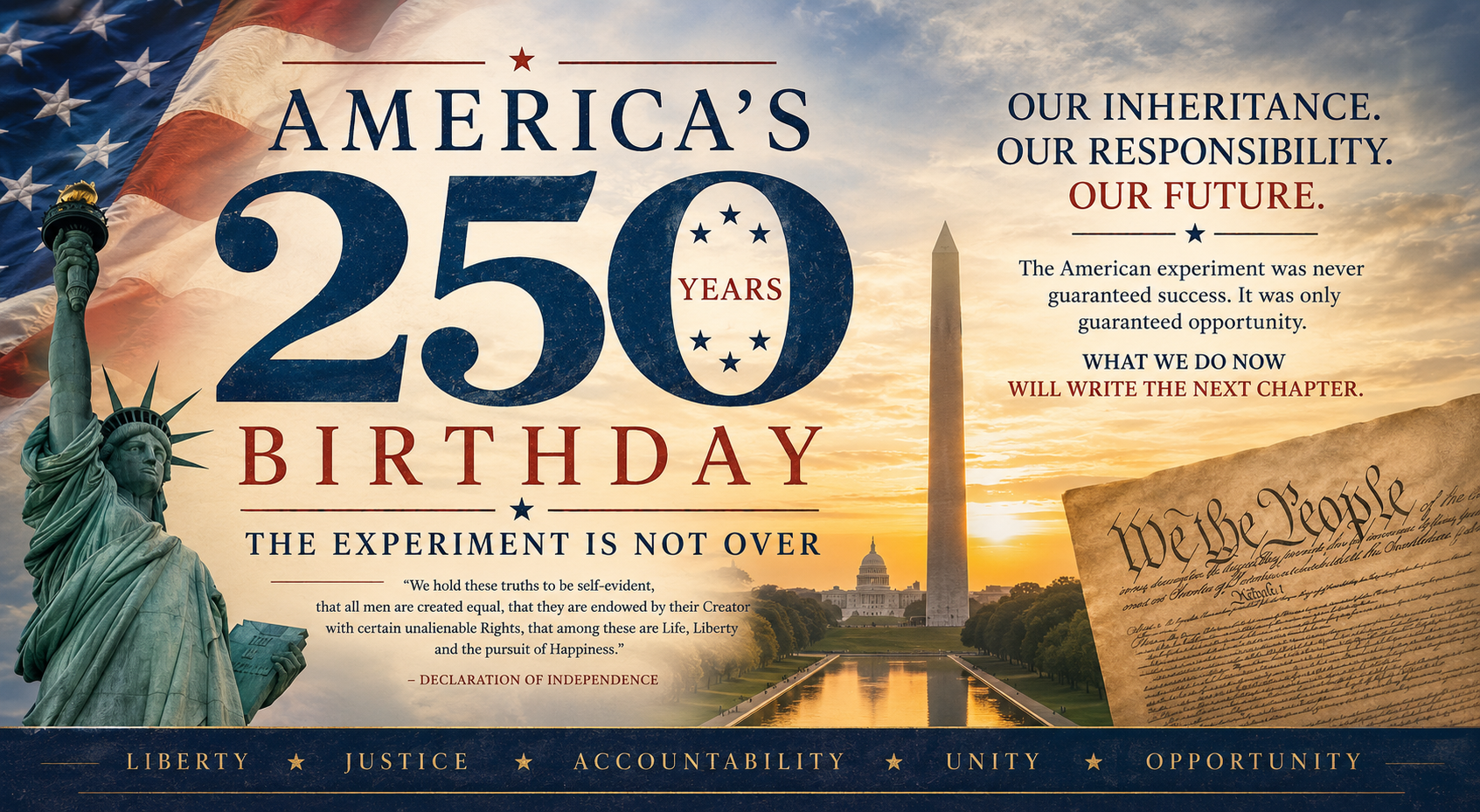
On July 4, 1776, a small collection of colonies did something the world considered improbable. They declared that governments derive "their just powers from the consent of the governed" and that liberty belonged not to kings, but to ordinary people.
Two hundred and fifty years later, that declaration remains one of history's boldest political experiments.
America's birthday should never be simply a celebration of our past. It should be a reflection on our future.
Like every nation, the United States has stumbled. We have fought a civil war, endured economic collapse, struggled through periods of injustice, and made mistakes both at home and abroad. We have often fallen short of our ideals.
But the remarkable story of America has never been that we were perfect.
It is that we possessed a Constitution strong enough to survive imperfect people.
Our founders did not create a government built upon the assumption that leaders would always be wise, virtuous, or competent. They assumed precisely the opposite. They understood that power accumulates, ambition corrupts, and majorities can become as dangerous as monarchs. Their answer was not blind trust. It was constitutional restraint.
Checks and balances.
Federalism.
An independent judiciary.
A free press.
The right of citizens to speak, worship, assemble, and criticize those who govern them.
These were not obstacles to democracy. They were democracy's insurance policy.
Today, however, we often speak as though America's future depends upon electing the right person. History suggests something different.
The strength of the United States has never rested in one president, one Congress, one political party, or one Supreme Court. It has rested in institutions that outlast personalities and in citizens willing to defend principles even when doing so disadvantages their own side.
That may be the greatest challenge facing America as it enters its next quarter millennium.
Political polarization has transformed opponents into enemies. Social media rewards outrage instead of understanding. Too many Americans now judge constitutional principles by whether they help or hinder today's political objectives. We celebrate limits on power only when someone else holds power.
That is a dangerous habit.
The Constitution was never intended to protect us from our political opponents. It was designed to protect all Americans from the abuse of power itself.
The world is also changing around us.
Authoritarian governments increasingly challenge the democratic order that America helped build after World War II. Technology is reshaping society faster than governments can adapt. Artificial intelligence, cyber warfare, and disinformation are redefining national security. The next generation will confront challenges the founders could scarcely imagine.
Yet the principles they established remain surprisingly resilient.
Individual liberty.
Equal justice under law.
The peaceful transfer of power.
Government accountable to the people.
These ideas remain revolutionary because they remain rare.
Having spent much of my career traveling across six continents and more than one hundred countries, I have seen societies where these principles exist only on paper. I have met people risking imprisonment simply for demanding the freedoms many Americans now take for granted. That perspective reminds me that democracy is neither inevitable nor permanent. It survives only when citizens choose to preserve it.
America's 250th birthday therefore should not be viewed as the culmination of our national story.
It is an inspection.
Are our institutions still worthy of public trust?
Do we still value disagreement without hatred?
Do we defend constitutional limits when they inconvenience our preferred leaders?
Do we still believe that character matters as much as policy?
The answers to those questions will determine whether future generations celebrate America's 300th birthday with the same confidence we celebrate the 250th.
Anniversaries invite nostalgia. History demands responsibility.
The founders handed us an extraordinary inheritance. Every generation since has either strengthened it or weakened it. Our generation will be no different.
The American experiment was never guaranteed success. It was only guaranteed opportunity.
Two hundred and fifty years ago, a handful of revolutionaries lit a beacon that inspired people across the world to believe that freedom could govern itself.
Whether that beacon burns brighter or begins to fade will not depend upon what happened in 1776.
It will depend upon what we choose to do from this day forward.