Stop waiting for the US to save Taiwan
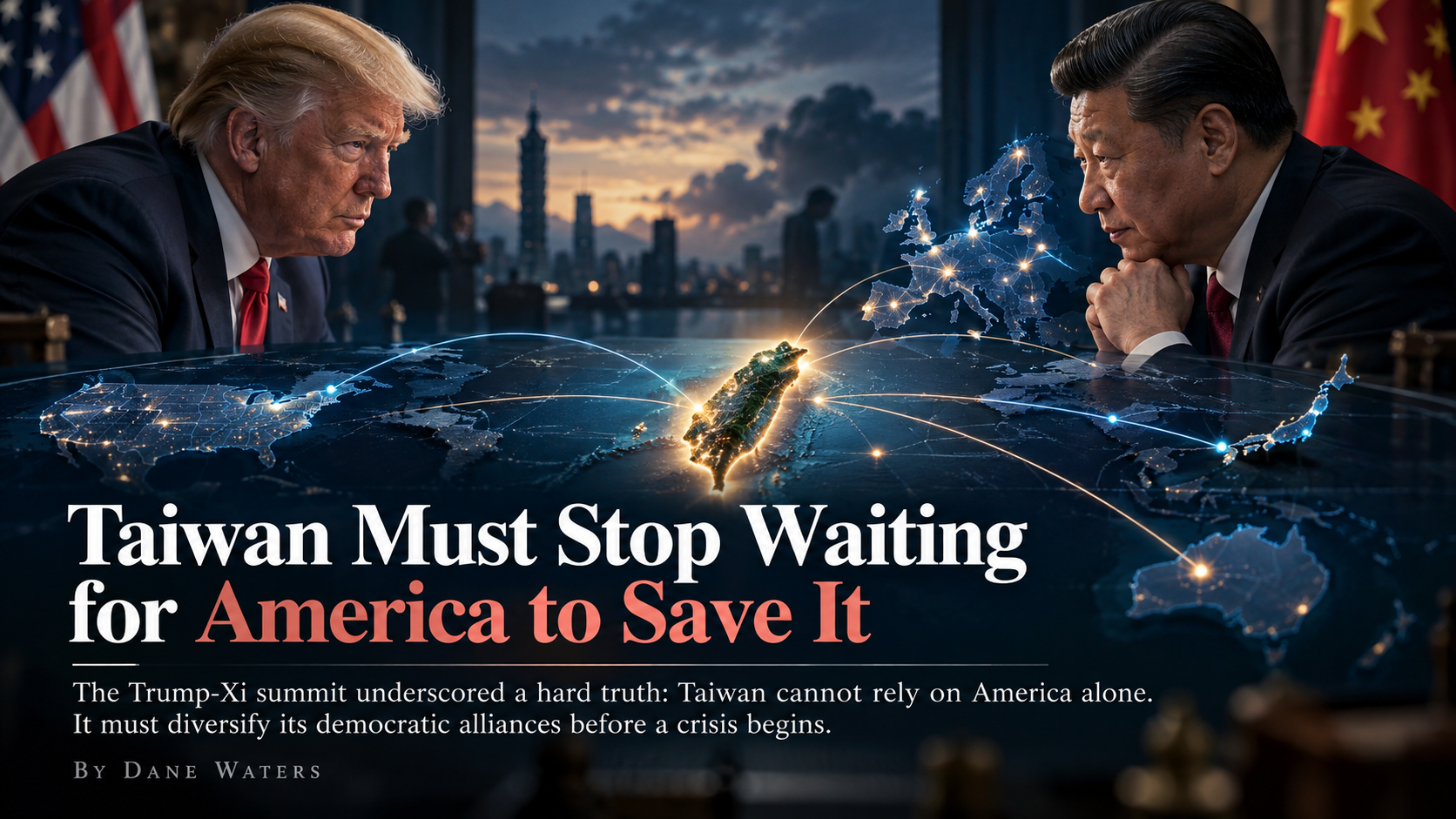
The most important lesson for Taiwan from this week’s summit between Donald Trump and Xi Jinping is not found in any formal agreement. It is found in the way Taiwan was treated: as an issue to be managed between Washington and Beijing. That should alarm Taipei.
Xi pressed Trump to adhere to what China called the “correct position” of opposing Taiwan independence — a stronger formulation than Washington’s traditional position that it does not support Taiwanese independence.
The timing matters. For six months, China has been watching the United States fight Iran. Beijing is not simply observing the battlefield. According to Taiwan’s own 2026 defense assessment, China is studying the lessons of that war: rapid American ammunition consumption, pressure on air-defense systems, the demands of industrial mobilization and what Taipei’s Defense Ministry called the “fragility of allied cooperation.”
Taiwan should study those lessons just as closely.
The Iran conflict, launched with U.S. and Israeli strikes in February, was initially presented by Trump as a war that could be won quickly. Instead, it has hardened into a costly stalemate. Iran, vastly weaker militarily than China, has nevertheless threatened American bases, disrupted energy flows, forced the United States to expend expensive defensive missiles and used regional partners to widen the conflict.
Trump has repeatedly threatened escalation while also leaving the door open to negotiations. Most European and Asian allies, meanwhile, have refused his demands to join a war they say was launched without adequate consultation.
Beijing is watching.
We cannot know precisely what conclusions Xi has drawn. But Taiwan would be reckless to assume he has drawn none.
China does not need to believe it can defeat the United States everywhere. It needs only to believe it can make intervention in the Taiwan Strait so militarily costly, economically disruptive and politically divisive that an American president ultimately chooses negotiation over escalation.
And China would be a far more formidable adversary than Iran: a much larger and more sophisticated military, an enormous industrial base, nuclear weapons and the advantage of fighting close to its own shores.
That gives new significance to Xi’s decision to press Trump on Taiwan this week.
Trump’s response should concern Taipei. A roughly $14 billion U.S. arms package for Taiwan remains on hold, and Trump has previously described it as a “very good negotiating chip.”
Taiwanese should remember those words.
A negotiating chip is something that can be traded.
None of this means America has become Taiwan’s enemy. The United States remains Taiwan’s most important security partner and weapons supplier, and congressional support remains substantial.
But Taiwan must distinguish between American support and an American guarantee.
There is no treaty obligating the United States to send its forces into a war with China. Strategic ambiguity may have helped preserve peace, but ambiguity is a dangerous foundation on which to stake the survival of 23 million people.
The lesson from Iran is diplomatic as well as military. The war has shown that even Washington cannot automatically assemble an international coalition behind its military actions. Trump has struggled to persuade longstanding allies to follow him, while also searching for a negotiated way out of a conflict American military power has not ended.
Xi can see this. So should Taiwan.
Taiwan’s response must not be anti-Americanism. It must be diversification.
The United States should remain a central pillar of Taiwan’s strategy, but it cannot remain the only pillar. Europe must become the second.
Taiwan should undertake a sustained diplomatic, economic and security campaign across Europe — particularly in Britain, France, Germany, Poland, the Czech Republic, Lithuania and other democracies willing to resist coercion. It should deepen semiconductor partnerships, cybersecurity cooperation, intelligence relationships, parliamentary ties and critical-infrastructure collaboration.
Europe does not need to recognize Taiwan diplomatically tomorrow or promise troops. The objective should be to create relationships so extensive that any Chinese blockade or attack would immediately carry political, technological and economic consequences across Europe.
The same strategy should reach farther: Japan, Australia, India, Canada, the Philippines and other democracies.
Taiwan is not merely a small island asking larger nations for protection. It is a successful democracy at the center of the global technology economy. Its semiconductor industry is essential to economies worldwide.
Taiwan must convert that importance into durable international relationships before a crisis begins.
The central question after the Trump-Xi summit is not whether America supports Taiwan. It does.
The question is whether Taiwan can safely assume that, when the decisive moment comes, an American president will risk direct war with nuclear-armed China to save it.
Iran should have taught Taiwan the answer: it cannot afford to make that assumption.
Hope is not a defense policy. Friendship is not a treaty. No democracy should entrust its survival to the decisions of one president in one capital.
Taiwan still needs America.
But the time has come for Taiwan to build a world in which it no longer needs America alone.