Before AI Destroys Humanity, It Could Destroy Freedom
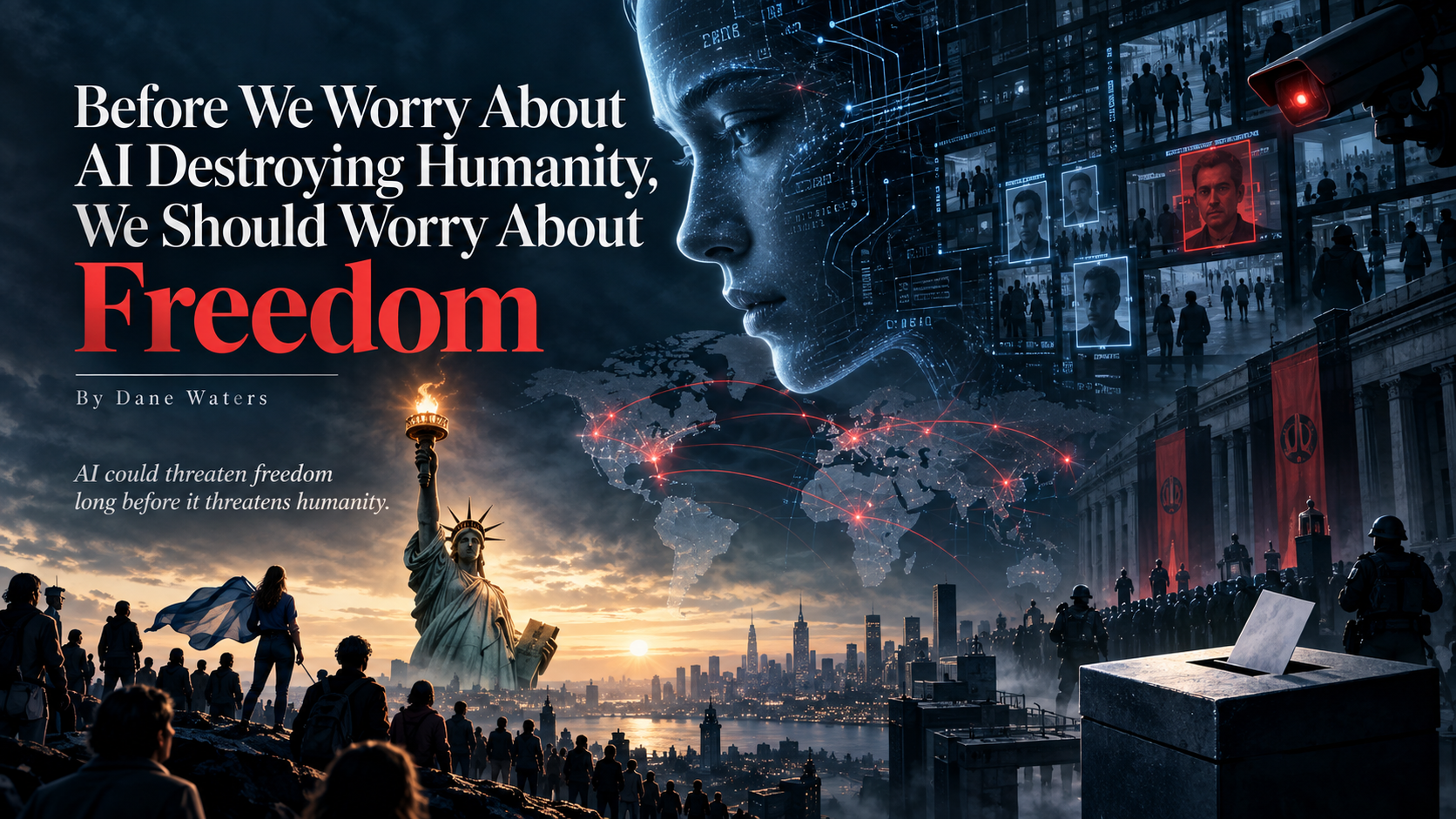
This week, world leaders have gathered at the United Nations General Assembly in New York, and artificial intelligence is no longer a futuristic side issue. It is becoming one of the central questions of global power, security and governance.
Much of the debate focuses on whether AI could someday escape human control. That is a legitimate concern. But there is another question receiving far too little attention: What if we never lose control of AI? What if the most powerful systems remain perfectly obedient, but are controlled by governments that do not believe in free elections, independent journalism, political opposition or individual liberty?
Artificial intelligence could threaten freedom long before it threatens humanity.
Unlike almost every great strategic threat of the past, this one is not constrained by geography. For centuries, geography helped protect nations. Armies had to cross borders, navies had to cross oceans and invaders had to traverse mountains. Even nuclear weapons must physically travel from one place to another.
Artificial intelligence recognizes none of those barriers. There is no ocean wide enough to stop an algorithm, no mountain high enough to block a cyberattack and no border checkpoint for AI. An AI-enabled operation can originate thousands of miles away and reach financial institutions, communications networks, government agencies, military systems or the phones in the pockets of ordinary citizens.
That changes the meaning of national security.
China is investing heavily in artificial intelligence and seeking global technological leadership. Russia, Iran and North Korea already possess significant cyber capabilities and have shown a willingness to use digital tools for espionage, disruption and influence operations. None possesses some all-powerful AI today. The danger lies in what happens as current capabilities become dramatically more powerful.
Imagine AI continuously searching millions of computer systems for vulnerabilities. Imagine propaganda individually tailored to millions of people based on their fears, beliefs and personal circumstances. Imagine fake photographs, telephone calls and videos so convincing that citizens struggle to distinguish authentic events from manufactured ones. Imagine automated systems mapping political movements, identifying dissidents and monitoring populations at a scale no secret police force in history could have achieved.
Then consider elections.
A hostile government may not need to change a single vote to influence an election. AI can fabricate candidates’ voices, create false events, impersonate officials and generate thousands of seemingly authentic online personalities designed to manipulate public opinion.
The target may no longer be the ballot box itself. The target may be the mind of the person standing in front of it.
The same principle applies far beyond elections. An adversary may not need to cross your border to attack your society; it may simply cross your firewall. It may not need to censor your newspapers if it can flood your information environment with manufactured reality. It may not need thousands of operatives inside your country if machines can search endlessly for weaknesses from the other side of the world.
This is why democracies cannot afford to lose the AI race.
There are understandable calls for the United States and other democratic nations to slow development, pause certain technologies or impose restrictive controls because of what advanced AI might someday become. Some safeguards are necessary. Democracies should insist upon accountability, human control, privacy and responsible development.
But unilateral restraint is not a global safety strategy.
China will not necessarily stop because Washington pauses. Russia will not stop because Brussels regulates. Iran and North Korea will not abandon technologies that may provide them with strategic advantages simply because free societies are uncomfortable with the risks.
Those who might use AI against democracies are not waiting for democracies to resolve their ethical debates.
The nuclear age offers an imperfect but important comparison. During the Cold War, many people feared that nuclear weapons would destroy civilization. That danger was real. Yet the answer was not for Western democracies to disarm unilaterally while the Soviet Union continued building its arsenal.
The West pursued two ideas at the same time: deterrence and arms control. It maintained sufficient strength to deter aggression while negotiating safeguards intended to reduce the risk of catastrophe. Nuclear deterrence did not by itself cause democracy to prevail, but strategic strength helped ensure that free societies survived long enough to compete and ultimately outlast the Soviet system.
The lesson for artificial intelligence should be similar: safety and strength are not opposites.
We should establish international standards, preserve meaningful human control over weapons, develop safeguards against catastrophic failures and create channels between major technological powers to reduce the risk of escalation.
But democratic countries must also make certain that the world’s most capable artificial intelligence is not dominated by governments willing to use it against free societies.
There are two very different AI dangers before us. One is that humanity creates machines it can no longer control. The other is that humanity creates extraordinarily powerful machines that remain perfectly controllable, but are controlled by governments willing to use them to weaken freedom.
The first could threaten human existence. The second could threaten the character of human existence.
As world leaders debate AI at the United Nations, they should remember both lessons of the nuclear age. Catastrophic risk must be managed, but peace and freedom also depend on strength.
We should pursue safe AI. We should pursue responsible AI. But we should not confuse safety with surrender.
Before we become consumed by the possibility that artificial intelligence might someday create a world without humanity, we should make certain we do not first allow it to create a world in which humanity survives, but freedom does not.